
Epiphany Day
Why writers leap out of bed at 3:30 a.m.

This morning, I woke up with an inspired way to strengthen the ending of my novel. As I lay in bed half-awake, I formulated three scenes I could add in different places in the narrative. It was 3:30 a.m. and minus 15 degrees, but I jumped out of bed and turned on my laptop. Then I saw that today was Epiphany.

Apparently, James Joyce is believed to be the first person to adopt the idea of epiphany in a literary context. Just as the three kings experienced revelation when they encountered the Christ child, Joyce recognized that writers, too, get flashes of insight, when the ordinary becomes luminous with meaning. Joyce’s character Stephen Daedalus (Portrait of a Young Man) defined epiphany as “a sudden spiritual manifestation, whether in the vulgarity of speech or of gesture or in a memorable phase of the mind itself.” Joyce believed writers should record these moments with extreme care, as they represented the most delicate and fleeting experiences.
But the Irishman’s radical insight was that epiphanies for writers were often trivial moments, memories and daydreams that offer new understanding of life. An overheard conversation on a tram. The way someone adjusts their collar. An idea surfacing at 3:30 in the morning.
Aha moments can’t be forced. But we can create the conditions that make them more likely. Virginia Woolf argued that women had to have money and a room of their own if they were to be creative. Catching a thought is a lot like fishing on a riverbank, she said. She let her line down into the stream where thought swayed among reflections and weeds. I’m reading Elif Shafak’s River in the Sky, and she would wholeheartedly agree.
Thomas Edison (not a writer, but creative) held a ball in each hand while he napped so that just as he nodded off, the orbs would fall and wake him. This was how he harnessed that brief period of creativity and insight that occurs in our brains just as we drift off.
Michelle Hoover points out that creative people sometimes do their best writing when they aren’t at their desks. What she means is that we are constantly ruminating even when we are shopping or hiking or sleeping. Our minds are small processors running in the background, trying to glue all the pieces together, trading the seams with gold in the process.
None of the work is wasted; it’s the groundwork that makes epiphanies possible.
Poet Jim Harrison says the ground work for epiphanies come for him when he’s put in all the work: those failed drafts, the wrestling with structure, the days when nothing seems to work. None of that is wasted effort; he’s laying the groundwork to makes illumination possible. Inspiration happens when we step away and let our subconscious work on problems we can’t consciously solve.
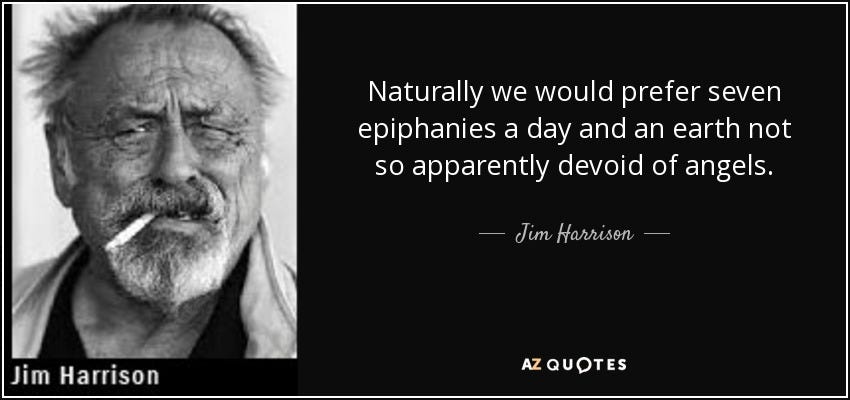
Epiphanies can be explosive and liberating. So we jump out of bed at 3:30 a.m. in minus 15 degrees. We have to capture these moments immediately. That’s why we call it creative energy. Joyce recorded more than 70 epiphanies throughout his career, treating them as precious raw material that they were. I once read that a writer (can’t remember who) filled a shoebox with overheard quotes, notes and ideas scribbled on the back of receipts, napkins and scrap paper. Others leave notepads by the bed or record voice memos on their phones. What matters is preserving what arrives.
Like the Magi tracking their star across the desert, we follow our curiosity and our questions through draft after draft. We prepare and create the space and time for epiphanies when they come.. We trust the journey itself will create the conditions for revelation.
Today, Epiphany on the Christian calendar, be inspired by Maya Angelou: “When I’m writing, I write. And then it’s as if the muse is convinced that I’m serious and says, ‘Okay. Okay. I’ll come.’” Even if the muse waits until 3:30 a.m.
Photo by Kid Circus on Unsplash
Enjoyed this. Thanks ❤️
i agree, and kudos to you, alison! youre on a roll, and deservedly so, you worked hard for it. keep on truckin'! 😁
yours, michael